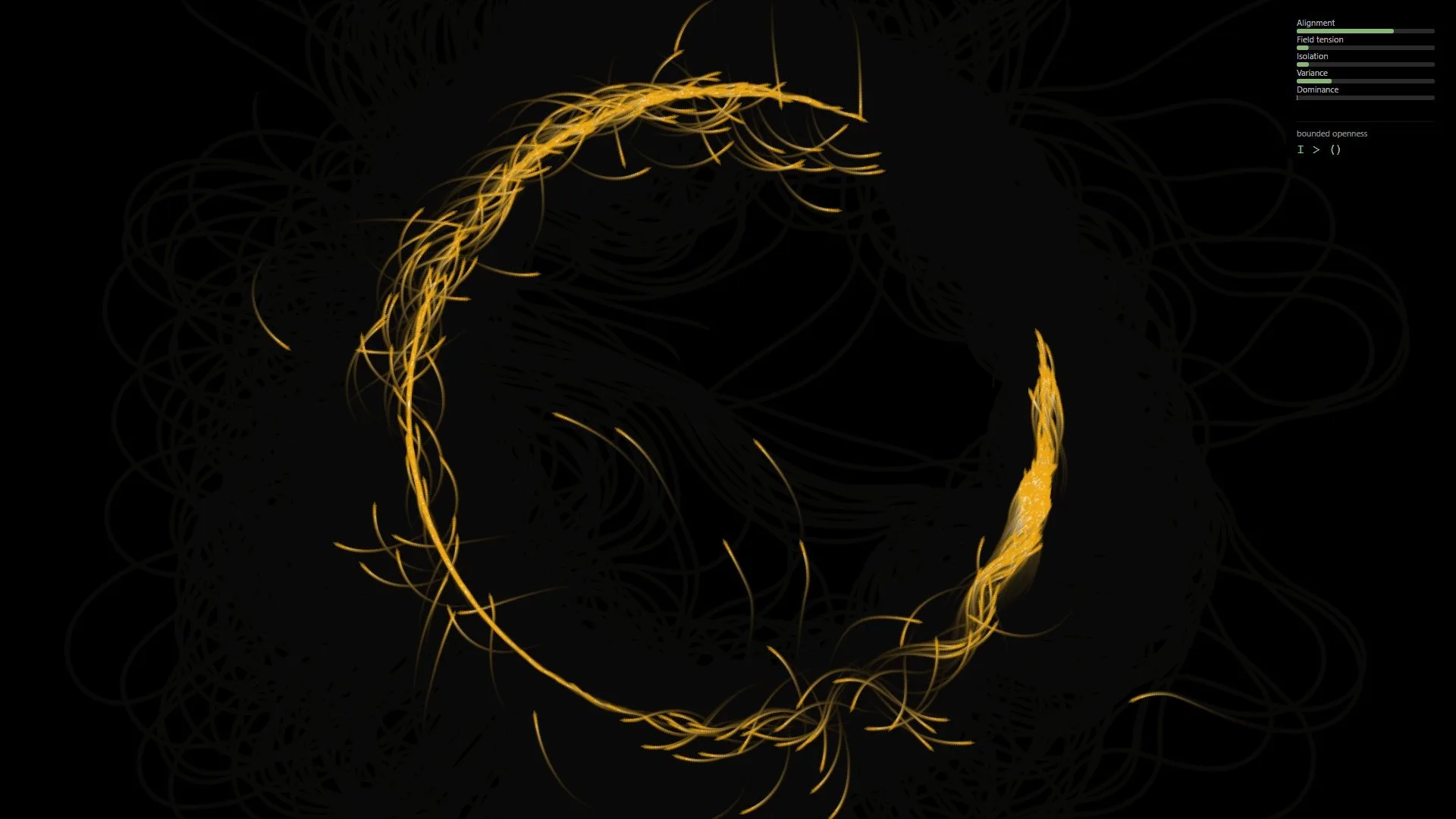
An experimental interface that makes collective dynamics visible and measurable in real time.
Hundreds of units move through an asymmetric field. Each unit carries its own direction, but is shaped by the field around it — and by the presence of others. The system observes itself in real time and names what it sees.
This is not a simulation of a specific phenomenon. It is a model of how possibility space, relational change and observation/distinction interact — the three operators at the core of the I·V·O lens.
What makes this interface different is the analytical layer underneath: the system continuously measures alignment, field tension, isolation, variance and dominance — and translates these into named system states using the IVO notation language.
The interface detects eight named states. Each state has an IVO notation — three symbols that describe observation/distinction, relational change and possibility space, aligned with the IVO Matrix v3.5.
High alignment, open field. Units move together with clarity and direction.
High alignment combined with high field tension. The system moves fast and together.
Alignment is present but the field is contained. Movement within a safe boundary.
High tension, low alignment, high variance. The system is under pressure and losing coherence.
Tension with no variance and no alignment. The system stiffens and implodes.
High isolation. Units drift apart and lose contact with the field and each other.
Partial alignment returning, high variance. The system searches for a new direction.
Low alignment, low tension, low variance. The system is present but still — no crisis, no direction.
Open the interface, press Start, and adjust the sliders. Watch the system name itself. Try increasing coupling — then raise the speed and see tension drop as units escape the field.
Open the interface → Runs in the browser — no installation required.Shot button captures a clean PNG — UI hidden, full resolution.